
Ever paused mid-sentence, wondering if it’s momma or mama? You’re not alone — this tiny spelling choice confuses writers, parents, and students every day.
Here’s the truth: both words are correct, but they don’t carry the same meaning or tone. In this guide, you’ll learn the real difference between momma and mama, when to use each one, and which spelling is actually correct for your writing.
Quick Answer
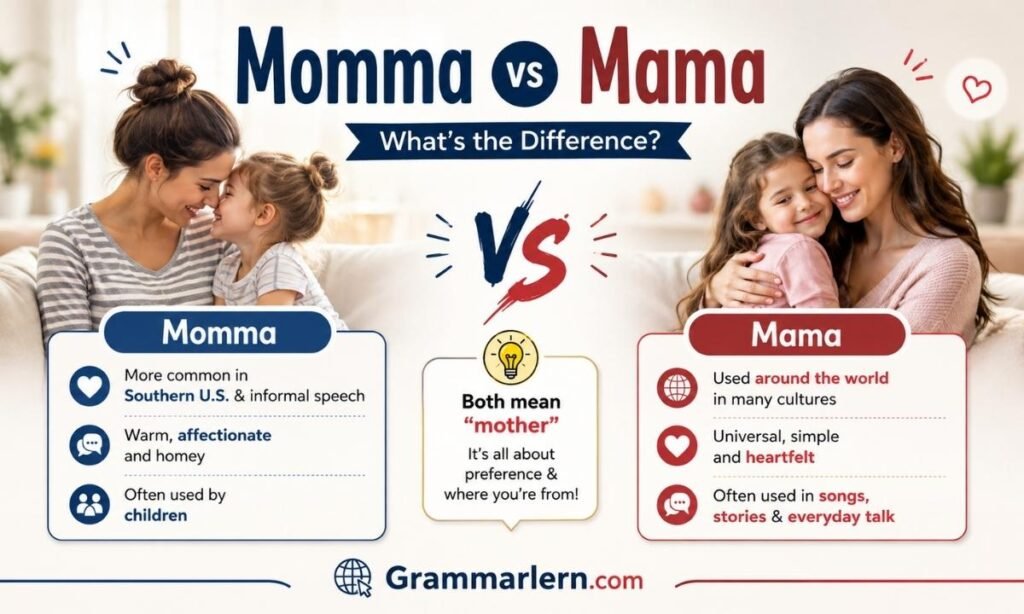
Both mama and momma are informal, affectionate words for “mother.”
- Mama is the more standard, widely recognized spelling used around the world.
- Momma is a phonetic variation common in Southern American English.
- Neither word belongs in formal writing — use mother instead.
If you’re ever unsure which one to use, “mama” is the safer, more universal choice.
What Does “Mama” Mean?
Mama is a warm, informal term for mother, used across cultures and languages. It’s often one of the very first words a baby learns to say, which is part of why it feels so instantly familiar and comforting.
Common Uses of “Mama”
- A young child calling out to their mother
- A loving nickname used within families
- Song lyrics, stories, and everyday cultural expressions
- Playful or affectionate speech among adults
Examples:
- “Mama, can you help me with my homework?”
- “I love you, Mama.”
- “She’s a proud mama of three.”
Tone and Feeling
“Mama” feels warm, loving, and nurturing. It carries a childlike softness that works well in both casual conversation and heartfelt writing. It’s common in American English and is also understood in British English, though used less often by adults in the UK.
What Does “Momma” Mean?
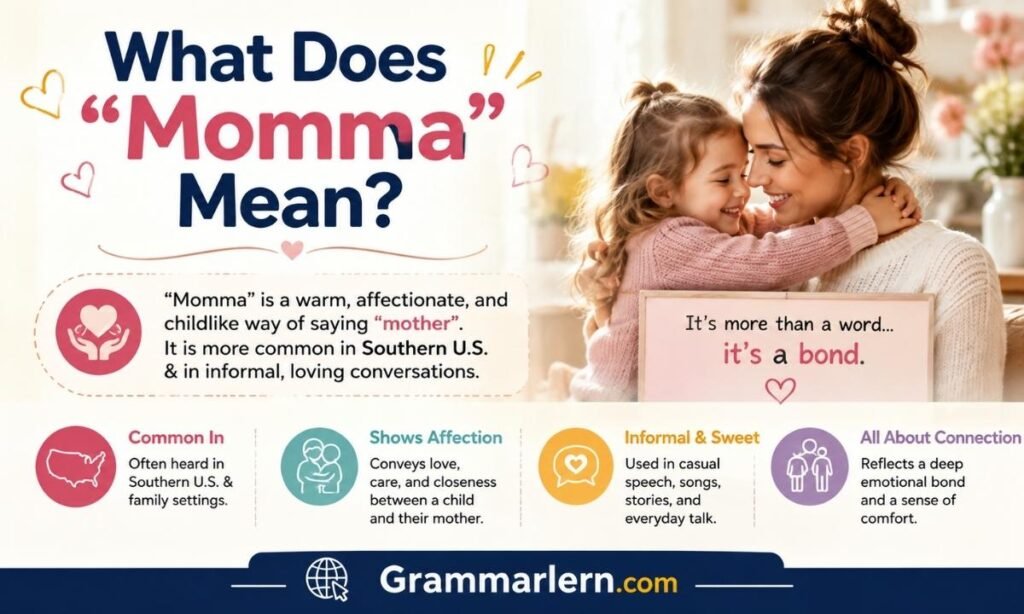
Momma means exactly the same thing as “mama.” The real difference lies in spelling and regional flavor rather than meaning.
“Momma” reflects how many Americans, especially in the Southern United States, naturally pronounce the word, giving extra emphasis to that strong “mom” sound.
Common Uses of “Momma”
- Southern American dialect and family speech
- Casual, nostalgic storytelling
- Dialogue meant to sound authentic and regional
Examples:
- “My momma always said to be kind.”
- “Momma knows best.”
- “That’s what momma used to cook every Sunday.”
Tone and Feeling
“Momma” feels folksy, personal, and nostalgic. It often shows up in country songs and family stories rooted in American tradition. Outside the U.S., it’s far less common and can read as distinctly regional.
Origin and History of “Mama” and “Momma”
The word “mama” is one of the oldest and most universal sounds in human language. Babies naturally produce the simple “ma” sound early in speech development, since it only requires opening the mouth and using the lips, no complex tongue movement needed.
This is why versions of “mama” appear across unrelated language families: mamá in Spanish, maman in French, mama in Swahili and several Asian languages. “Momma” developed later as an English spelling variation, shaped by regional pronunciation rather than a separate linguistic origin.
Also Read This Perform vs Preform: Meaning, Usage & Key Differences
How to Pronounce “Mama” and “Momma”
- Mama is pronounced MAH-mah, with a soft, open “a” sound in both syllables.
- Momma is pronounced MOM-ah, with a shorter, rounder “o” sound that reflects Southern American speech patterns.
The spelling difference mirrors how each word actually sounds when spoken aloud, which is part of why “momma” feels more regional and conversational.
Momma vs Mama: Side-by-Side Comparison
| Feature | Mama | Momma |
| Meaning | Informal word for mother | Same meaning |
| Formality | Informal | Informal |
| Common region | Widely used globally | Mainly American, especially the South |
| Spelling style | Standard informal spelling | Phonetic, dialect-based variation |
| Safe for general writing? | Yes | Only in informal or regional context |
American vs British English Differences
In American English, both words are used, but they carry different associations. “Mama” feels universal and neutral, while “momma” is strongly tied to Southern culture and family storytelling.
In British English, the standard informal term is “mum.” “Mama” occasionally appears in baby talk, but “momma” is rare and often reads as distinctly American.
If you’re writing for an international audience, “mama” is the safer, more widely understood choice. Save “mother” for anything formal.
When Should You Use “Mama”?
Use “mama” when:
- Writing children’s content or bedtime stories
- Expressing affection in personal essays or captions
- Writing songs, poems, or heartfelt messages
- Addressing your own mother lovingly
Example: “Being a mama has changed my life in the most beautiful way.”
When Should You Use “Momma”?
Use “momma” when:
- Writing dialogue in Southern American dialect
- Quoting someone authentically
- Creating a nostalgic, regional tone
- Telling a personal story rooted in family tradition
Example: “Momma always said hard work pays off.”
If you’re writing SEO content or professional copy for a broad audience, “mama” is generally the better fit.
Plural and Possessive Forms
Both words follow standard noun rules for plurals and possessives.
- Plural: mamas, mommas — as in, “All the mommas gathered at the school gate.”
- Possessive: mama’s, momma’s — as in, “Momma’s cooking is the best in town.”
Capitalize the word when it’s used as a name in direct address, such as “I love you, Mama,” but keep it lowercase when used generally, as in “She’s a loving mama.”
Common Mistakes to Avoid
1. Using “Momma” in Formal Writing
Incorrect: “My momma attended the conference.” Correct: “My mother attended the conference.”
2. Mixing Regional Tone Unintentionally
If your content is meant to feel neutral or international, using “momma” can feel out of place and inconsistent with the rest of your tone.
3. Confusing “Mama” With “Mamma”
“Mamma,” spelled with a double m, is a less common variant seen mostly in older British English and titles like Mamma Mia! It isn’t standard in modern everyday writing.
4. Overusing Informal Terms
In academic, business, or professional communication, always use “mother” or “parent” instead of “mama” or “momma.”
Is One More Correct Than the Other?
Grammatically, both are correct informal spellings, and neither is “wrong.” That said, “mama” is the standard informal spelling, while “momma” is a dialect-based variation.
If you’re writing content for a broad, general audience, “mama” tends to perform better simply because it’s more widely recognized and understood.
Cultural and Emotional Context
Variations of “mama” appear across countless cultures and languages, from mamá in Spanish to maman in French to mama in many African and Asian languages. It’s one of the most universal words in human speech, often among the very first sounds a baby makes.
In Italian, “mamma” (double m) is the standard word for mother, distinct from the English “mama” or “momma.” “Momma,” by contrast, carries a distinctly American warmth, often appearing in country songs, rural storytelling, and family-centered narratives.
Common Idioms and Expressions
Both words appear in familiar English idioms and expressions:
- Mama bear — a fiercely protective mother
- Mama’s boy — a man seen as overly attached to his mother
- Momma’s boy — the informal, Southern-leaning spelling of the same phrase
- Yo mama jokes — a well-known style of playful, teasing humor
These expressions show how deeply both words are woven into everyday English, well beyond simple address.
Real-Life Example Sentences
With “Mama”:
- “Mama, I missed you.”
- “She’s a new mama learning every day.”
- “That’s my strong mama.”
With “Momma”:
- “Momma raised us right.”
- “I’m going back home to see momma.”
- “Listen to your momma.”
Notice how the emotional warmth stays the same in both — only the regional flavor shifts.
Frequently Asked Questions
Which is correct, mama or momma?
Both are correct informal words for mother. “Mama” is the more standard, globally recognized spelling, while “momma” is a regional variation common in the Southern United States.
Is momma or mama more common?
“Mama” is more common worldwide and appears more often in writing, media, and everyday speech. “Momma” is popular mainly in American Southern dialects and country music.
Who is called momma?
“Momma” is used the same way as “mama,” as an affectionate name for one’s mother. Some people also use it to describe a grandmother or an older female relative in casual family speech.
Do southerners say momma or mama?
Yes, “momma” is strongly associated with Southern American English. Many Southern families use it in everyday conversation as a warm, familiar term for their mother.
Can you use “momma” or “mama” in formal writing?
No, neither word fits formal or professional writing. In essays, reports, or business communication, “mother” is the correct and expected term.
Is “mamma” the same as “mama”?
“Mamma” is a less common spelling of the same word. It appears mostly in older British English and titles like Mamma Mia!, but it isn’t standard in everyday modern writing.
How do you pronounce “mama” and “momma”?
“Mama” is pronounced MAH-mah, with a soft, open “a” sound. “Momma” is pronounced MOM-ah, with a shorter, rounder “o” sound reflecting Southern American pronunciation.
Final Thoughts
Choosing between momma vs mama really comes down to context, not correctness. “Mama” works best for a broad, general audience, while “momma” adds a warm, Southern touch to personal or nostalgic writing.
Whichever word you pick, save “mother” for formal writing and let “mama” or “momma” carry the warmth in everyday conversation. Small as it seems, this simple choice can shape the tone of your entire message.