


Wondering if the plural of chief is chiefs or chieves? You’re not alone. Many people assume it follows the same -f to -ves rule as thief → thieves.
The truth is simple: the correct plural of chief is chiefs, not chieves. In this guide, you’ll learn why chief breaks the pattern and how to use it correctly every time.
Quick Answer
The plural of chief is chiefs. You form it the regular way, by simply adding -s to the end of the word — no spelling change required.
So if you’ve been typing “chieves” and hesitating before hitting send, you can stop second-guessing yourself. Chiefs is the only correct form in both formal and everyday English.
Also Read This Also Read This Reschedule To or For? Correct Usage Explained
Chief vs Chieves — Clearing the Confusion
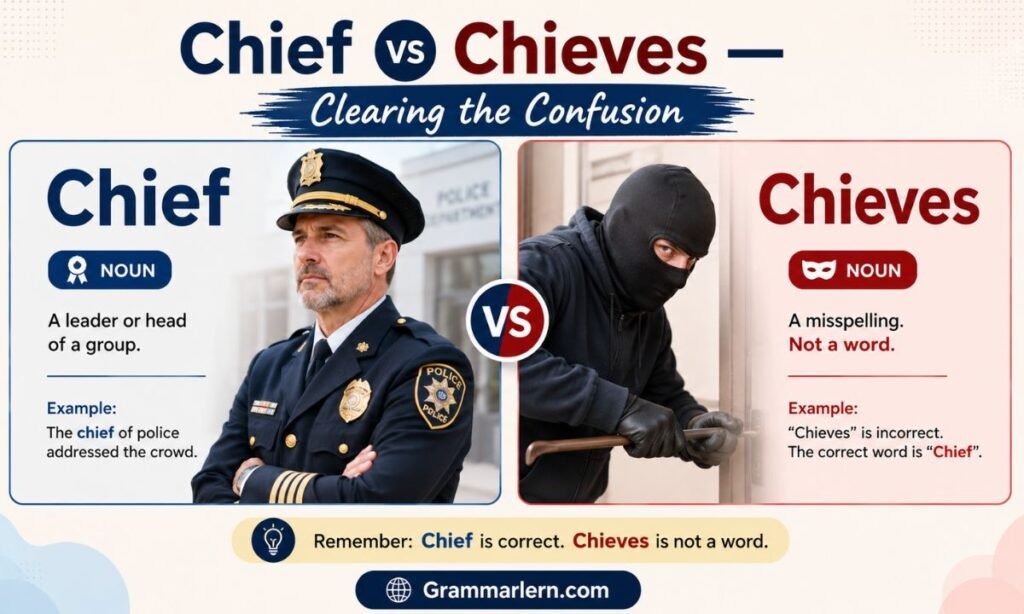
The confusion makes sense. English has trained you to expect words ending in -f to shift to -ves in the plural — knife → knives, leaf → leaves, and most notably, thief → thieves. Since chief looks and sounds so close to thief, it’s natural to assume it follows the same path.
But chief doesn’t behave like thief. It keeps its spelling and simply takes an -s, giving you chiefs. There is no rule that forces every -f word into the same pattern — English pluralization is far less uniform than it appears, and chief is one of the words that sticks to the regular route.
English Plural Rules for Nouns Ending in -F
Nouns ending in -f or -fe don’t all behave the same way. Linguists generally group them into three patterns, and knowing which group a word falls into is the only reliable way to get the plural right.
Nouns That Always Change to -ves
Some words consistently swap the -f for -ves. This group includes knife → knives, leaf → leaves, life → lives, wife → wives, and thief → thieves. These are largely native, Old English-rooted words, and the shift is baked into how they’ve always been pronounced and spelled.
Nouns That Simply Add -s
Other words, including chief, ignore the -ves shift entirely and just take a regular -s. Examples include chief → chiefs, roof → roofs, belief → beliefs, and cliff → cliffs. These words tend to have non-Germanic origins, which is part of why they don’t follow the older Germanic sound-change pattern.
Nouns With Two Accepted Plural Forms
A smaller group accepts both forms, depending on style or region. Scarf can be scarfs or scarves, and dwarf can be dwarfs or dwarves. This flexibility doesn’t apply to chief — only chiefs is considered correct.
Why Chief Follows the Regular Plural Rule
The real reason comes down to word origin. Chief entered English from the Old French word chef, meaning “leader” or “head” (itself from the Latin caput, meaning “head”). Words with this French and Latin ancestry generally don’t carry the old Germanic -f to -ves sound shift that affects native English words like thief and leaf.
That’s the key distinction: thief is a native Germanic word, while chief arrived later through French. Different linguistic histories, different plural behavior — which is exactly why chiefs is correct and chieves isn’t.
Also Read This Reschedule To or For? Correct Usage Explained
Is the Plural of Chief the Same in British and American English?
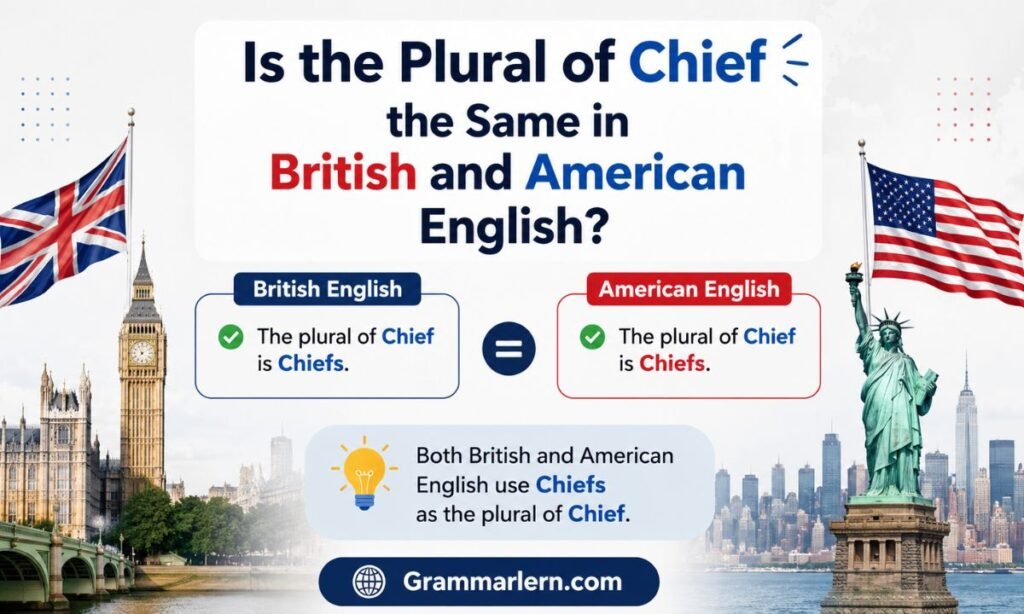
Yes. Unlike some grammar points that shift between British and American English, the plural of chief doesn’t change. Chiefs is standard in both varieties, used the same way in UK newspapers, US publications, dictionaries, and everyday speech. There’s no regional exception to watch out for here.
Example Sentences Using Chiefs
Seeing the word in context makes it easier to remember:
- The village chiefs gathered to discuss the harvest.
- Several police chiefs attended the security briefing.
- The company’s department chiefs met to review the budget.
In every case, chiefs simply means more than one leader — the spelling never shifts, no matter the setting.
Plural of Chief in Compound Words (Chief of Staff, Commander-in-Chief)
Compound terms built around chief follow their own logic, and it trips people up often. For chief of staff, the plural is chiefs of staff — the main noun (“chief”) takes the plural marker, not the word at the end. The same applies to commander-in-chief, which becomes commanders-in-chief in the plural.
This is a common mistake even among fluent speakers, who instinctively want to add “-s” to the last word instead. Remembering that the core noun takes the plural — not the final word — solves the problem instantly.
Related Plurals of Similar Words (Cliff, Gulf, Belief, Handkerchief, Leaf, Knife, Roof)
Comparing chief with similar words makes the pattern click faster:
- Cliff → cliffs
- Gulf → gulfs
- Belief → beliefs
- Handkerchief → handkerchiefs
- Leaf → leaves
- Knife → knives
- Roof → roofs
Notice that cliff, gulf, belief, handkerchief, and roof all follow the same regular pattern as chief — simply add -s. Only leaf and knife shift to -ves, reinforcing that there’s no single rule for every -f word; each one has to be learned individually.
Common Grammar Mistakes
The most frequent error is writing chieves instead of chiefs, usually because of the mental association with thief → thieves. Another common slip happens with compound words — writing “chief of staffs” instead of the correct chiefs of staff.
A simple way to avoid both mistakes: remember that chief is not thief, and in compound phrases, the plural always attaches to the main noun, not the last word in the phrase.
Quick Grammar Tip
If a word ending in -f just sounds odd with -ves, trust that instinct. Chiefs sounds natural; chieves doesn’t — and that’s because it isn’t a real word. When in doubt, default to adding -s, since most -f words in modern English (including chief) follow the regular pattern rather than the older -ves shift.
Frequently Asked Questions
What is the plural of chief?
The plural of chief is chiefs, formed by simply adding -s to the singular noun.
Is it chiefs or chieves?
Chiefs is correct. Chieves is not a recognized English word and should never be used.
Why don’t we say chieves instead of chiefs?
Because chief comes from Old French (via Latin), it doesn’t follow the Germanic -f to -ves sound shift that affects native words like thief and leaf. That’s why it stays regular.
Is the plural of chief the same in British English?
Yes. Chiefs is used consistently in both British and American English, with no regional variation.
What is the plural of chief of staff?
The plural is chiefs of staff. The main noun, “chief,” takes the plural marker rather than the word “staff.”
Is “chef” singular or plural?
Chef is a singular noun on its own — a different word from chief, meaning a professional cook. Its plural is chefs, not to be confused with chiefs.
Final Thoughts
The plural of chief comes down to one simple fact: it’s chiefs, formed the regular way, with no spelling changes involved. The confusion with chieves comes from comparing it to thief, but the two words have entirely different origins and don’t share the same plural pattern.
Once you remember that chief traces back to Old French rather than native English roots, the rule stops feeling random. It also extends naturally to compound terms like chiefs of staff and commanders-in-chief, where the main noun — not the last word — carries the plural.
Next time you’re unsure, skip the guesswork: chiefs is always the safe, correct choice.