

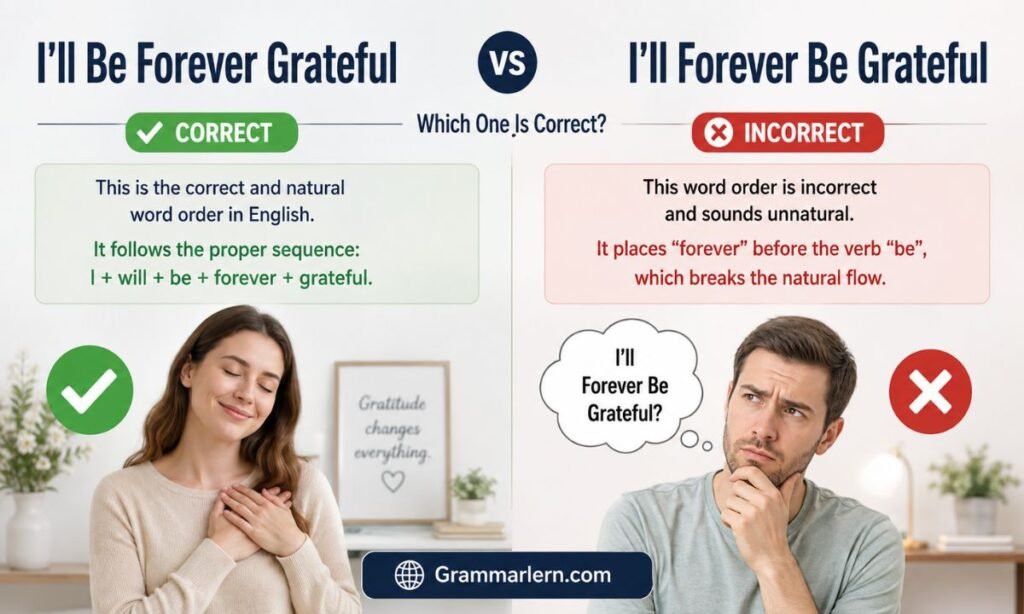
Ever paused mid-sentence, unsure if it’s “I’ll be forever grateful” or “I’ll forever be grateful”? You’re not alone — this small word-order swap trips up even confident writers and native speakers. The good news is simple: both phrases are grammatically correct.
The real difference comes down to word order, emphasis, and natural flow — not right versus wrong grammar. One version feels smoother in everyday conversation, while the other adds a touch of emotional weight. This guide breaks down exactly which one to use, and when.
What Does “I’ll Be Forever Grateful” Mean?
“I’ll be forever grateful” means your appreciation for someone or something will never fade. It expresses gratitude that lasts a lifetime, not just a passing thank-you for a single moment.
People use this phrase when a favor, kindness, or support feels too significant to forget — a mentor’s guidance, a friend’s help during a hard time, or a life-changing opportunity someone gave them.
Quick Answer
Both “I’ll be forever grateful” and “I’ll forever be grateful” are correct. The only real difference is where the word forever sits in the sentence.
“I’ll be forever grateful” sounds more natural and is used more often in everyday speech and writing. “I’ll forever be grateful” shifts slight emphasis onto the word forever, giving the sentence a bit more emotional weight.
If you’re unsure which to pick, “I’ll be forever grateful” is the safer, more common choice.
Comparison Table
| Feature | I’ll Be Forever Grateful | I’ll Forever Be Grateful |
| Grammar | Correct | Correct |
| Meaning | Lasting gratitude | Lasting gratitude |
| Word order | Adverb after “be” | Adverb before “be” |
| Natural in conversation | Very common | Common |
| Emphasis | Balanced | Slightly stronger on “forever” |
| Best for | Everyday writing, emails, thank-you notes | Speeches, emotional writing, toasts |
Are Both Grammatically Correct?
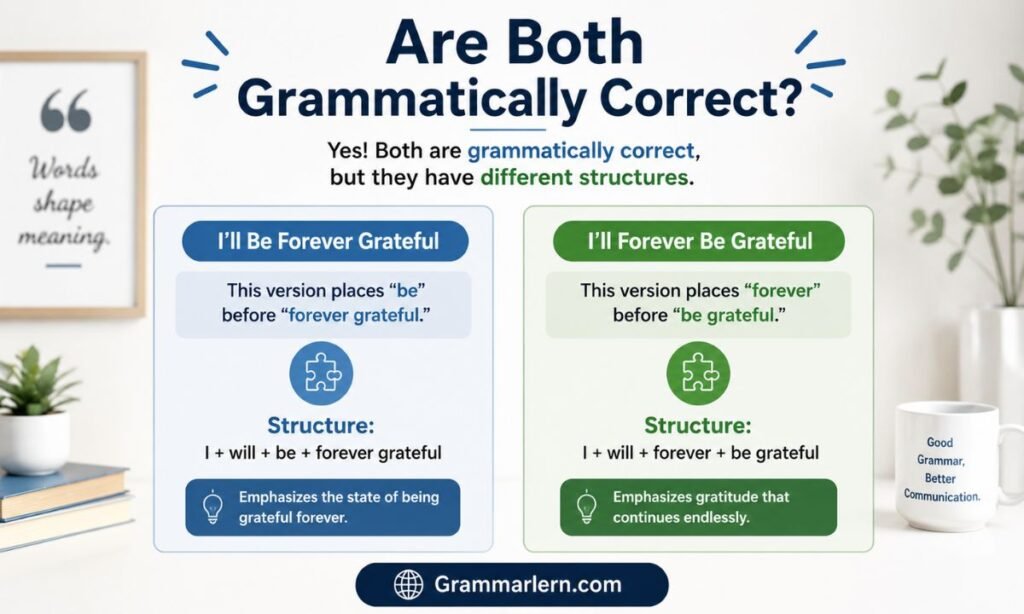
Yes — both sentences follow standard English grammar. English allows certain adverbs, including forever, to move around a sentence without breaking any rule or changing the core meaning.
Why Both Sentences Work
Adverbs like always, never, and forever are flexible. They can sit before or after a verb phrase and still sound natural. For example, “I will always remember you” and “I always will remember you” are both understandable, even though one flows better.
The same logic applies here. “I’ll be forever grateful” and “I’ll forever be grateful” both use forever correctly — just in different positions.
Also Read Thias Also Read This Acception vs Exception: What’s the Real Difference?
The Role of Forever as an Adverb
Forever is an adverb that modifies the state of being grateful. It tells the listener that the gratitude has no end point. Whether it appears right after “be” or right before it, the word is still doing the same job — extending the feeling of thankfulness across time.
What’s the Difference Between the Two Phrases?
Although the meaning stays nearly identical, small shifts in word order, emphasis, and tone separate these two phrases.
Word Order
In “I’ll be forever grateful,” forever comes after the verb be — a pattern native speakers hear constantly. In “I’ll forever be grateful,” forever comes before the verb phrase, which is also correct but less frequent in casual speech.
Emphasis
“I’ll be forever grateful” keeps the focus balanced across the whole sentence. “I’ll forever be grateful” draws slightly more attention to the word forever, making the gratitude feel a touch stronger.
Tone
Both phrases sound warm and sincere. “I’ll be forever grateful” feels relaxed and conversational, fitting almost any setting. “I’ll forever be grateful” feels a little more expressive, which is why it shows up more often in speeches and heartfelt messages.
Which Sounds More Natural?
For everyday English, “I’ll be forever grateful” is the more natural-sounding choice. It’s the version native speakers reach for most often in conversations, emails, and thank-you notes.
“I’ll forever be grateful” isn’t wrong or awkward — it’s simply used a little less frequently, mostly in moments that call for extra emotional emphasis.
When Should You Use “I’ll Be Forever Grateful”?
Use this version when you want your writing to sound smooth, natural, and easy to read. It works well in:
- Thank-you emails
- Business communication
- Personal letters
- Everyday conversation
- Appreciation messages
Example: “I’ll be forever grateful for your support during this difficult time.”
When Should You Use “I’ll Forever Be Grateful”?
Choose this version when you want to add a bit more weight to your appreciation. It fits naturally in:
- Emotional speeches
- Wedding toasts
- Personal reflections
- Heartfelt thank-you notes
Example: “I’ll forever be grateful for your kindness.”
Also Read This Acception vs Exception: What’s the Real Difference?
Examples in Different Contexts
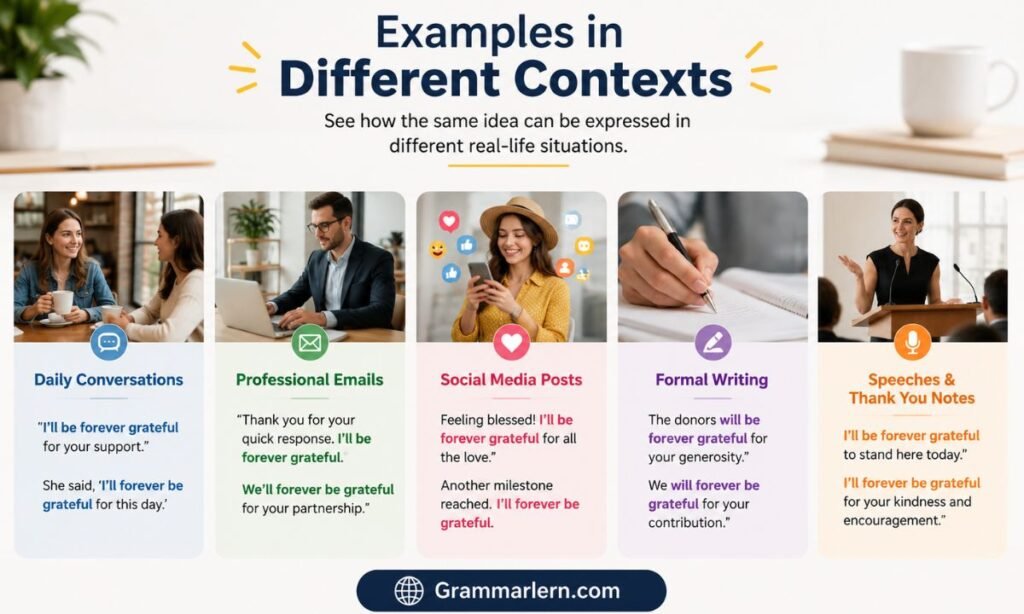
Formal Examples
- I’ll be forever grateful for your professional guidance.
- Our organization will be forever grateful for your contribution.
Informal Examples
- I’ll be forever grateful for having a friend like you.
- I’ll forever be grateful for everything you’ve done.
Business Email Examples
- I’ll be forever grateful for the opportunity to work with your team.
- We will be forever grateful for your continued trust and support.
Graduation Speech Examples
- I’ll forever be grateful to my teachers for believing in me.
- I’ll be forever grateful to my parents for encouraging me every step of the way.
I’ll Be Forever Grateful to You — Quotes
Short, heartfelt lines like these work well in cards, speeches, or messages:
- “I’ll be forever grateful to have you in my life.”
- “Your kindness is something I’ll be forever grateful for.”
- “I’ll forever be grateful for the moment our paths crossed.”
- “Some people leave footprints on your heart — I’ll be forever grateful for yours.”
Common Mistakes
Writers sometimes misplace the adverb or overcomplicate the sentence.
Incorrect
❌ I’ll forever grateful. → ✅ I’ll forever be grateful.
❌ I’ll be grateful forever always. → ✅ I’ll be forever grateful.
❌ I forever will grateful. → ✅ I’ll forever be grateful.
Reading the sentence aloud usually reveals whether it sounds natural or forced.
Similar Expressions
If you want variety in your writing, try these alternatives:
- I’ll always be grateful.
- I’m forever thankful.
- I’m deeply grateful.
- I’m eternally grateful.
- I can’t thank you enough.
- You’ll always have my gratitude.
- I’ll never forget your generosity.
Grammar Tip: Does Adverb Placement Change Meaning?
Not really. English gives writers flexibility with adverbs like forever, always, and never. Moving them around changes the sentence’s rhythm and emphasis, but the core meaning stays the same.
Compare: “I’ll always remember you” and “I’ll remember you always.” Both work — it’s simply a matter of style, not correctness.
Which Phrase Should You Choose?
Pick “I’ll be forever grateful” if you want a natural, everyday tone for emails, letters, or conversation. Pick “I’ll forever be grateful” if you want slightly more emotional emphasis for speeches or heartfelt writing.
Either way, you’re using correct, natural English — the choice simply comes down to the mood you want to create.
Frequently Asked Questions
Is “I’ll be forever grateful” grammatically correct?
Yes. It’s a completely correct sentence and one of the most common ways to express lasting gratitude in English.
What does “I’ll be forever grateful” mean?
It means your gratitude toward someone or something will never fade — it’s a promise of lasting appreciation.
Can you say “I am forever grateful”?
Yes. This present-tense version is also correct. It expresses gratitude you already feel right now and will continue to feel, while “I’ll be forever grateful” leans slightly more toward an ongoing, future-facing promise.
Which phrase is more common — “I’ll be forever grateful” or “I’ll forever be grateful”?
“I’ll be forever grateful” is the more common and natural-sounding choice in everyday English, though both are used and understood equally well.
What is another way to say “forever grateful”?
You can say “eternally grateful,” “always grateful,” “deeply grateful,” or “forever thankful” — all carry the same lasting sense of appreciation.
What ayat in the Quran talks about gratitude?
Surah Ibrahim, verse 7 (14:7), is widely cited for this theme. It’s commonly translated along the lines of: “If you are grateful, I will surely increase you [in favor].” The verse links gratitude directly to increased blessing.
Final Thoughts
At the end of the day, both “I’ll be forever grateful” and “I’ll forever be grateful“ are correct, natural ways to express lasting appreciation. The only real difference lies in word order and emphasis — not grammar.
Whether you’re writing a thank-you email, a wedding speech, or a heartfelt message, you can use either phrase with confidence. When in doubt, “I’ll be forever grateful” remains the smoothest, most widely used choice for everyday English.