

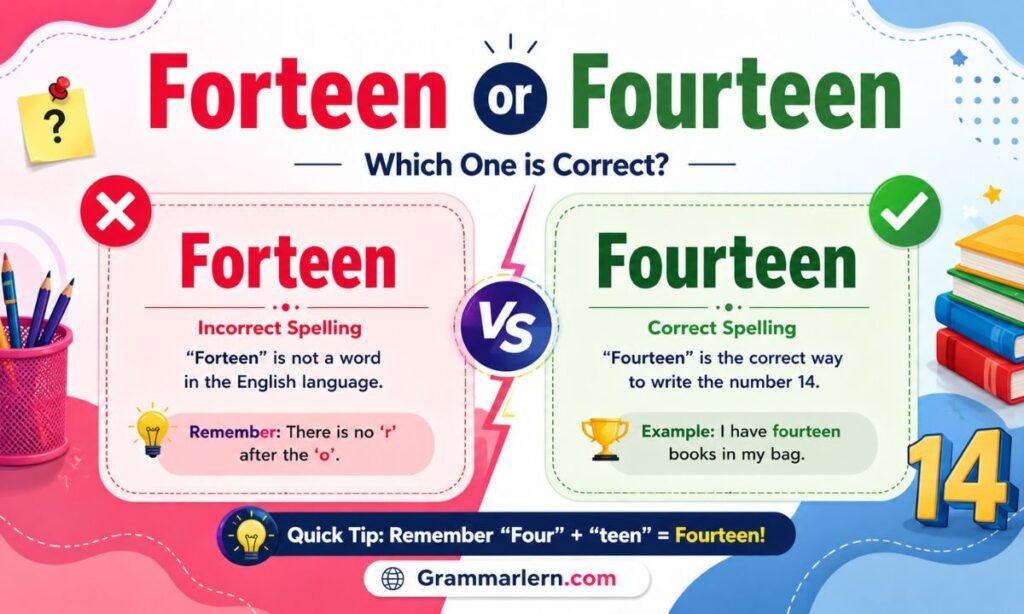
Confused about forteen or fourteen? You are not alone, and the answer is simpler than it feels. The correct spelling is fourteen, while “forteen” is a common mistake caused by how the word sounds when spoken. This small mix up trips up students, writers, and even professionals every single day.
The confusion usually starts because fourteen keeps the “u” from the word “four,” unlike forty, which drops it completely. Once you understand this simple pattern, you will never second guess this spelling again. In this guide, you will find the correct spelling, real examples, and easy tricks to remember it for good.
Fourteen
✅ Correct spelling. This is the only accepted form of the number 14 in standard English.
Forteen
❌ Incorrect spelling. This word does not exist in any dictionary and should never be used in writing.
Fourteen or Forteen: Quick Answer
“Fourteen” is the correct spelling. “Forteen” is wrong. There is no exception, no regional version, and no informal case where “forteen” becomes acceptable.
Correct:
- Fourteen students joined the class.
- She waited fourteen days for a reply.
- The book has fourteen chapters.
Incorrect:
- ❌ Forteen students joined the class.
- ❌ Forteen days passed before the reply.
Easy rule to remember: If you can spell four, you can spell fourteen. Just add “teen” to the end.
Fourteen or Forteen: Which One Is Correct in English?
Many people search phrases like fourteen or forteen which is correct, is it fourteen or forteen, or forteen or fourteen in English. The answer stays the same across every one of these searches: fourteen is correct, and forteen is simply a spelling mistake.
This confusion happens because people try to spell the word the way it sounds. When spoken quickly, “fourteen” can come out closer to “for teen,” which nudges writers toward the wrong form. If you ever pause on how to spell fourteen, remember the simple structure behind it:
four + teen = fourteen
This rule works the same way in exams, emails, business writing, and casual conversation. There is no situation where the spelling changes.
The Origin of Fourteen or Forteen
The word fourteen comes from Old English. It is built from two clear parts:
- Four, the number
- Teen, meaning ten more
English number words historically followed the same pattern. Thirteen comes from three plus teen, fourteen comes from four plus teen, and fifteen comes from five plus teen. The spelling of each number word stayed close to its root number, which is exactly why fourteen keeps the “u” from four.
The spelling forteen has never existed as a proper form in English. It only shows up as a mistake, almost always because of how the word sounds when spoken aloud. English spelling does not always follow pronunciation, and this word is a clear example of that gap.
How to Pronounce Fourteen (British vs American English)
Getting the pronunciation right can also help you remember the correct spelling. According to the Oxford Learner’s Dictionary, fourteen is pronounced slightly differently depending on the accent:
- British English: /ˌfɔːˈtiːn/
- American English: /ˌfɔːrˈtiːn/
The main difference is the “r” sound after the first syllable, which American English pronounces clearly while British English softens it. In both accents, the stress falls on the second syllable, “teen,” which is why the word is often written as four-TEEN in pronunciation guides. Practicing this stress pattern out loud can help train your ear away from the “forteen” mistake.
British English vs American English Spelling
There is no difference between British and American spelling for this word. Both use fourteen, and both reject forteen completely.
Comparison Table
| Region | Correct Spelling | Incorrect Spelling |
| British English | Fourteen | Forteen |
| American English | Fourteen | Forteen |
| Australian English | Fourteen | Forteen |
| Canadian English | Fourteen | Forteen |
Unlike words such as colour or centre, numbers do not change across regional versions of English. This is one of the few areas where every English speaking country agrees completely.
Fourteen vs Fourteenth: Cardinal and Ordinal Numbers
Fourteen and fourteenth look similar, but they serve different grammatical roles.
Fourteen is a cardinal number. It tells you how many of something there are. For example, “There are fourteen students in the class” simply counts the students.
Fourteenth is an ordinal number. It tells you the position or order of something in a sequence. For example, “She finished in fourteenth place” tells you where she ranked, not how many people were involved.
A simple way to remember the difference: cardinal numbers answer “how many,” while ordinal numbers answer “in what order.” Fourteenth always keeps the same spelling pattern as fourteen, just with “th” added at the end.
Numeral or Word: When to Write “14” vs “Fourteen”
Whether to write the number as a word or as a numeral depends on context and the style guide you follow. As a general rule, spell out the word in formal writing and use the numeral in technical or data heavy content.
Some quick situations to consider:
- Start of a sentence: Always spell it out. For example, “Fourteen students attended the workshop.”
- Technical or scientific writing: Use the numeral, such as “14 kilometers” or “14 grams.”
- Fractions and decimals: Numerals are clearer, such as “14.5 inches.”
- Large numbers: Use the numeral when it is part of a bigger figure, such as “14 million dollars.”
Style Guide Rules (APA, MLA, Chicago, AP)
Different style guides handle this number differently, so it helps to know which rule applies to your writing:
| Style Guide | Rule for 14 |
| APA Style | Use numerals for numbers 10 and above, so write “14” |
| MLA Style | Spell out numbers that take one or two words, so write “fourteen” |
| Chicago Style | Spell out numbers from zero to one hundred, so write “fourteen” |
| AP Style | Use numerals from 10 onward, so write “14” |
If you are unsure which guide applies, spelling it out as “fourteen” is almost always the safer choice for general or formal writing.
Which Spelling Should You Use?
You should always use fourteen. There is no context, audience, or writing style where forteen becomes correct.
Based on audience:
- United States: Use fourteen
- United Kingdom: Use fourteen
- Commonwealth countries: Use fourteen
- International or ESL writing: Use fourteen
Whether your writing is academic, professional, casual, or online, the answer never changes. One spelling, one rule, no exceptions.
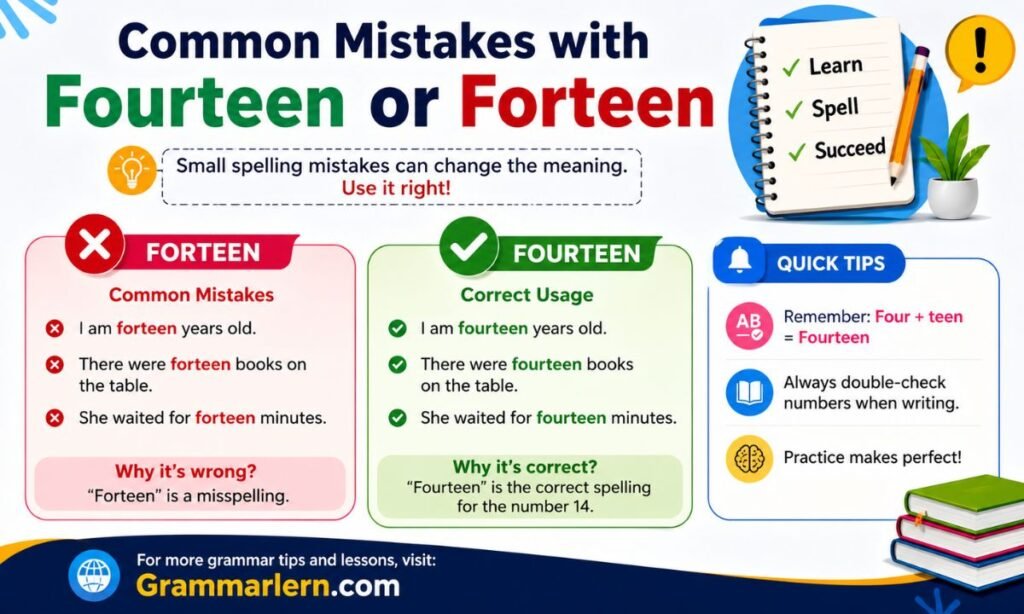
Common Mistakes with Fourteen or Forteen
This word causes mistakes for a few clear and repeatable reasons.
1. Writing “forteen”
This is the most common error, and it happens because people spell the word by sound rather than by rule. ❌ Forteen ✅ Fourteen
2. Dropping the “u”
Some writers assume the “u” is silent and unnecessary, so they leave it out entirely. ❌ Forteen ✅ Fourteen
3. Mixing with “forty”
Since forty genuinely has no “u,” people assume fourteen should follow the same pattern. These two words simply follow different spelling rules, and mixing them up is one of the most common number spelling mistakes in English.
Fourteen as a Word: Grammar and Usage
Beyond spelling, fourteen also plays specific grammatical roles depending on how it is used in a sentence.
Fourteen as a Noun or Adjective
Fourteen can function as a noun, such as in “Fourteen is my lucky number,” where it acts as the subject of the sentence. It can also work as an adjective, such as in “Fourteen players joined the tournament,” where it describes the noun that follows it.
Hyphenation Rules (e.g., “fourteen-year-old”)
When fourteen combines with another word to describe a noun, use a hyphen to join them. For example, “a fourteen-year-old student” is correct, while “a fourteen year old student” without hyphens can read as unclear. This rule applies whenever the number and the following words act together as a single descriptive phrase before a noun.
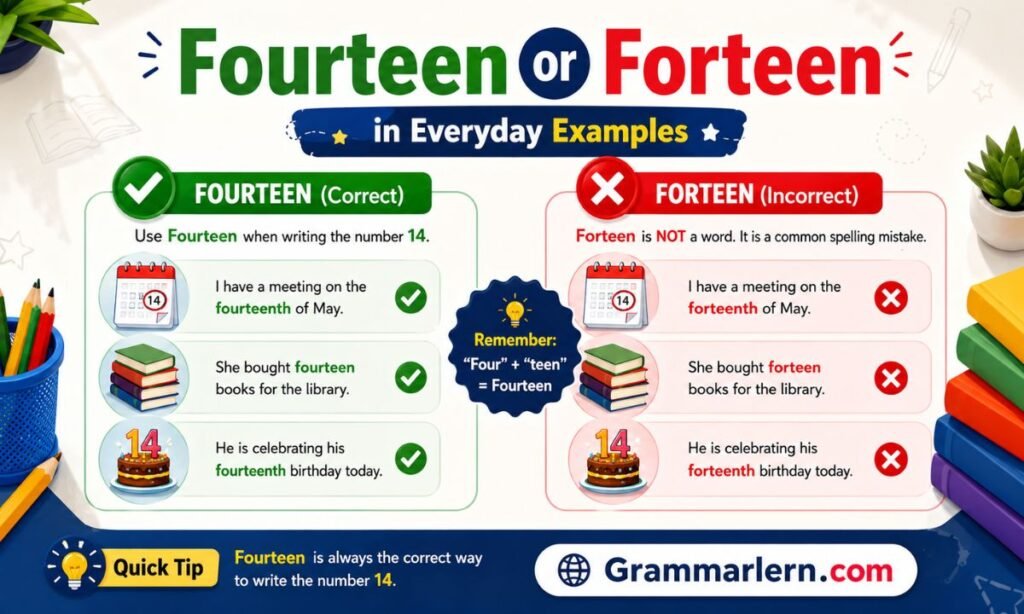
Fourteen or Forteen in Everyday Examples
Emails
- Please submit the form within fourteen days.
- The meeting is scheduled for fourteen members.
News
- Fourteen people were rescued from the area.
- The team won fourteen matches this season.
Social Media
- Just turned fourteen today.
- Fourteen days of hard work finally paid off.
Formal Writing
- The study observed fourteen separate cases.
- Fourteen participants completed the process.
Cheques and Legal Documents
When writing a cheque or a legal document, numbers must always be spelled out in full to avoid tampering or confusion. For example, a cheque for 14 dollars should read “Fourteen dollars only,” never “Forteen dollars.” Getting this wrong on a financial or legal document can cause real delays or rejections.
Fourteen or Forteen: Google Trends & Usage Data
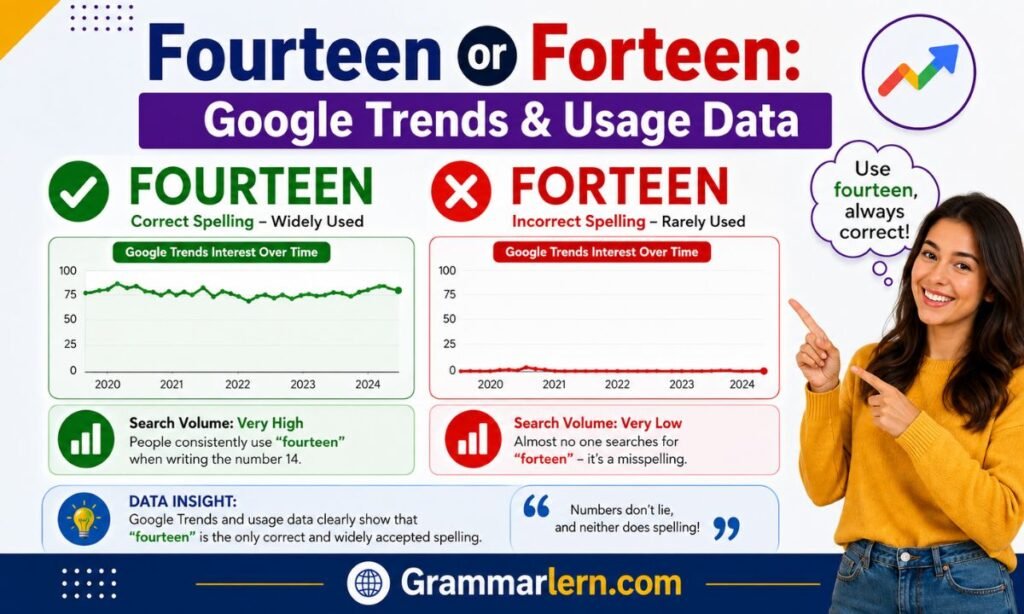
Search behavior around this word follows a clear and consistent pattern.
By country:
Correct usage of fourteen dominates search and writing patterns in the United States, United Kingdom, Canada, and Australia. Searches for the incorrect form mostly come from regions where English is learned as a second language, usually as part of a spelling check rather than genuine confusion about meaning.
By context:
Education websites frequently explain this difference for students preparing for exams. Writing and grammar tools flag forteen as an error automatically. Most people searching this term are not looking for alternatives, they are looking for confirmation that fourteen is correct.
Comparison Table: Fourteen vs Forteen
| Feature | Fourteen | Forteen |
| Correct spelling | Yes | No |
| Recognized by dictionaries | Yes | No |
| Used in books and news | Yes | No |
| Accepted in exams | Yes | No |
| Based on word history | Yes | No |
Only one form passes every test, and that form is fourteen.
How to Spell Fourteen With Examples and Common Uses
A common question people ask is how do you spell fourteen or what is the correct spelling of 14. The answer is always the same: fourteen, written the same way across every form of English.
Here are a few common variations to keep in mind:
- 14 in words: fourteen
- 14th: fourteenth
- Fourteen thousand: 14,000, used the same way as any other number followed by “thousand”
Some people also search forteen meaning or forteen spelling, but it helps to understand that forteen carries no meaning at all, since it is not a real word in any dictionary. Whenever you are writing numbers in exams, documents, or cheques, sticking with the correct form, fourteen, keeps your writing accurate and professional.
Frequently Asked Questions
Is 14 spelled as “forteen” or “fourteen”?
The correct spelling is fourteen. “Forteen” is a common misspelling and has no place in standard English, whether formal or casual.
Is it fourteen or 14?
Both are correct, but the choice depends on context. Spell out fourteen in formal writing or at the start of a sentence, and use the numeral 14 in technical, statistical, or informal content.
Is fourty or forty correct?
Forty is correct. Unlike fourteen, forty drops the “u” from “four,” which is exactly why the two words confuse so many writers.
What does forteen mean?
“Forteen” has no meaning. It is not a recognized English word, just a misspelling of fourteen caused by how the word sounds when spoken quickly.
Is forteen or fourteen used in British English?
British English uses fourteen, the same as American English. There is no regional version where “forteen” becomes acceptable.
What does the Oxford Dictionary say about fourteen?
The Oxford Learner’s Dictionary confirms fourteen as the correct spelling, tracing it to the Old English word “fēowertīene,” formed from “four” and “teen.”
Final Thoughts
The confusion around forteen or fourteen comes down to one simple fact: fourteen is always correct, and forteen is not a real word in any form of English. This mix up happens because the word sounds different than it is written, especially when compared to “forty.”
Once you connect fourteen back to its root word “four,” the spelling becomes easy to remember and hard to forget. Whether you are writing an email, a school assignment, or a formal document, sticking with fourteen keeps your writing clear and professional.
Small spelling details like this one shape how readers perceive your writing. Get this one right, and you will never pause over fourteen again.