

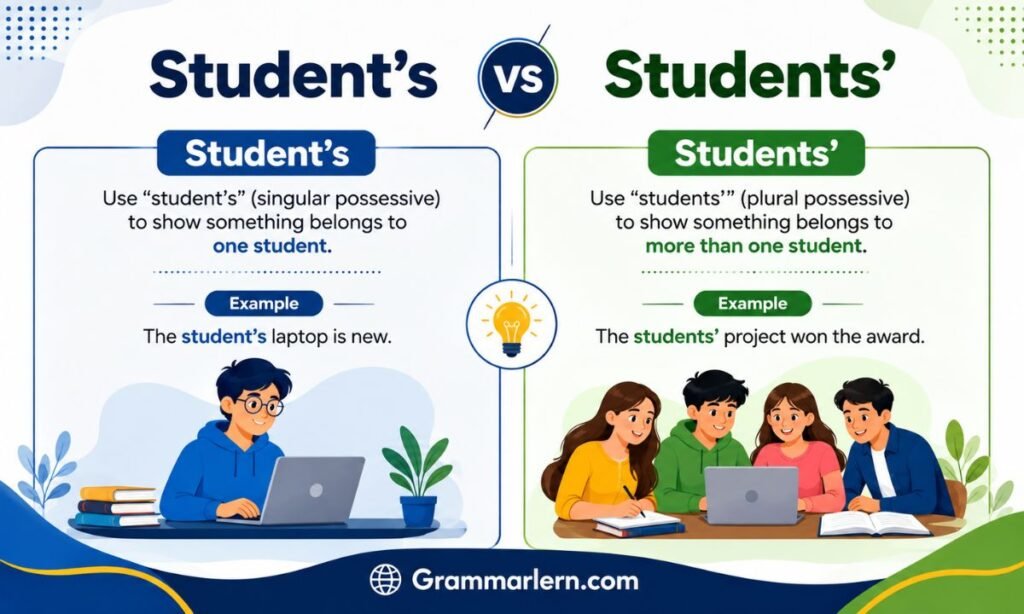
A wrong apostrophe can change the entire meaning of a sentence. Student’s and students’ look almost the same, but they mean very different things. This mix up happens to almost every writer at some point.
The good news is that the rule behind it is simple. All you need to check is one thing: who owns what, one student or many students. This guide will teach you that trick in just a couple of minutes.
Students vs Student’s vs Students’: Quick Answer
Students means more than one student. It is a simple plural with no ownership involved.
Student’s means something belongs to one student. It is a singular possessive form.
Students’ means something belongs to more than one student. It is a plural possessive form.
Examples
The students are in the library. (plural, no ownership)
The student’s bag is missing. (belongs to one student)
The students’ bags are missing. (belongs to many students)
Students vs Student’s vs Students’: Definitions with Examples & Top Queries
Students (Definition)
Students is the plural form of student. It simply refers to more than one learner, with no possession involved at all.
Examples
All students must submit their assignments by Friday.
The new students joined the orientation session.
Student’s (Definition)
Student’s is the singular possessive form. It shows that something belongs to, or is connected with, one student.
Examples
The student’s notebook was left on the desk.
I read the student’s essay before the deadline.
Students’ (Definition)
Students’ is the plural possessive form. It shows that something belongs to, or relates to, more than one student.
Examples
The students’ project impressed the entire panel.
The teacher collected the students’ assignments early.
User Queries
People commonly search for these related phrases when trying to understand this topic.
Students vs student’s vs students’ difference
Is students possessive or plural
Student’s or students’ correct usage
How to use apostrophe with students
Plural possessive of student
Student or Students: Understanding Singular and Plural Forms
Before apostrophes even come into the picture, it helps to understand the base forms. Student refers to one learner. Students is simply the plural, meaning more than one learner.
The rule for making it plural is easy. You add an s to the end of the word. Student becomes students, following one of the most basic patterns in English.
This step matters because plural and possessive forms often get confused. Once the plural form is clear, adding possession on top of it becomes much easier to understand.
Plural vs Possessive: The Core Rule
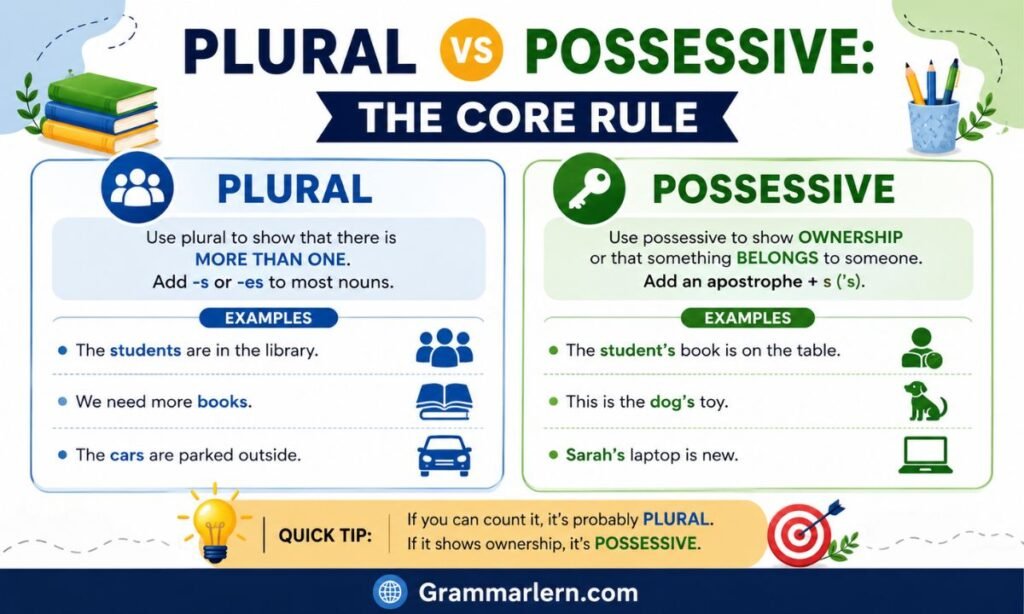
Every confusion around this topic comes down to one core idea. Plural tells you how many. Possessive tells you who owns something.
Students only tells you that there is more than one learner. It does not tell you that anything belongs to them. The moment ownership enters the sentence, an apostrophe becomes necessary.
Is Students Possessive or Plural?
Students on its own is only plural. It never shows possession by itself. If you want to show that something belongs to students, you must add an apostrophe after the final s, turning it into students’.
Students vs Student’s vs Students’: Which One Should You Use?
Use Students When
You are talking about more than one student and nothing belongs to them.
Example: The students arrived early for the test.
Use Student’s When
One student owns, wrote, or is connected to something.
Example: The student’s phone rang during class.
Use Students’ When
More than one student owns or shares something.
Example: The students’ results were announced today.
Memory Trick
Ask yourself two quick questions. Is there more than one student. Does something belong to them. If the answer to the second question is no, use students. If one student owns it, use student’s. If many students own it, use students’.
Student’s or Students’: How Apostrophes Change Meaning
A single apostrophe can shift a sentence from talking about one person to talking about an entire group. This is why the position of the apostrophe matters so much.
Consider this pair of sentences. The student’s locker was searched. This means only one locker belonged to one student. The students’ lockers were searched. This means multiple lockers belonged to multiple students.
Both sentences look almost identical, yet they describe completely different situations. Taking a second to check the apostrophe placement avoids this kind of confusion entirely.
Comparison Table
| Form | Meaning | Type | Example |
| Students | More than one student | Plural | Students are studying |
| Student’s | Belongs to one student | Singular possessive | Student’s book |
| Students’ | Belongs to many students | Plural possessive | Students’ books |
British vs American English
There is no real difference between British and American English when it comes to these three forms. The same rules apply everywhere. Any variation you notice usually comes down to individual writing style rather than regional grammar.
Common Mistakes with Students vs Student’s vs Students’
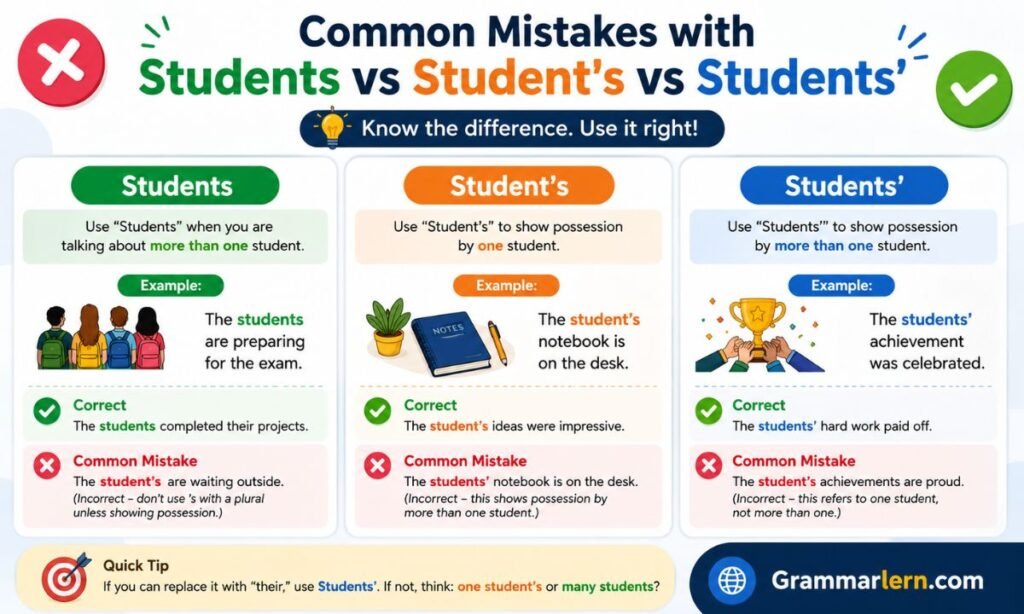
1. Using an apostrophe for a plural
Writers sometimes add an apostrophe just because a word ends in s. This is incorrect. Student’s are here should be Students are here.
2. Forgetting the apostrophe for possession
Skipping the apostrophe when ownership is involved changes the meaning. The students books should be written as the students’ books.
3. Confusing singular and plural possession
Some writers use student’s when they mean many students, or the other way around. Always check whether one person or a group owns the item before choosing the form.
4. Guessing instead of checking meaning
Many mistakes happen simply because writers rely on how a sentence sounds. Reading the sentence and asking who owns what almost always gives the correct answer.
Special Cases & Tricky Situations
Names Ending in S
Names that already end in s, such as James or Chris, usually take an apostrophe and an extra s in most modern style guides, as in James’s book. Some publishers prefer just an apostrophe, as in James’. Either style is acceptable as long as it stays consistent throughout your writing.
One of the Students or One of the Student’s
The correct phrase is one of the students, since it refers to a member of a larger group and does not involve possession.
Institutional Phrases
Certain phrases have become fixed expressions. Students’ union refers to a union representing all students collectively. Student’s handbook usually refers to a handbook meant for an individual student, though many schools also use students’ handbook when it applies to the entire student body.
Students vs Student’s vs Students’ in Everyday Examples
Daily Life
The students are getting ready for the trip.
The student’s umbrella was left behind.
The students’ bags were checked at the gate.
Social Media
Proud of my students this semester.
The student’s artwork went viral online.
The students’ teamwork stood out in the video.
School Writing
The students completed their final exams.
The student’s answer sheet was reviewed carefully.
The students’ overall performance improved this term.
Professional Writing
The students attended the training workshop.
The student’s internship report was well organized.
The students’ feedback helped improve the course.
The Origin of Students vs Student’s vs Students’
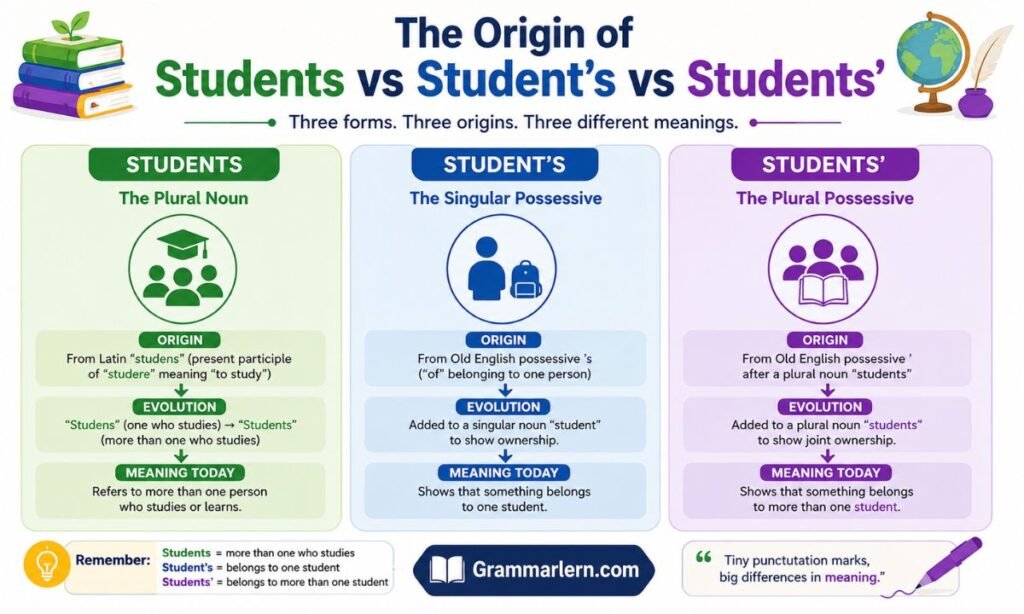
English uses two simple tools to handle number and ownership. Adding an s creates a plural. Adding an apostrophe, sometimes with an extra s, creates possession.
Student becomes students to show more than one learner. Student becomes student’s to show something belonging to one learner. Students becomes students’ to show something belonging to a group of learners.
This system developed over centuries as English grammar settled into clearer written rules, giving writers a consistent way to separate quantity from ownership.
Students vs Student’s vs Students’: Usage Trends & Popularity
Key Insight
Students is by far the most commonly used of the three forms, since most everyday sentences involve quantity rather than possession.
Trend
Mistakes usually happen with the possessive forms rather than the plain plural. Writers tend to either skip the apostrophe when it is needed or add one when it is not.
Students or Student’s: Common Grammar Questions Explained
A frequent question is whether to write students or students’ in a given sentence. The answer always comes down to possession. If nothing belongs to the students, use the plain plural. If something belongs to them as a group, use students’.
Another common question involves phrases like the students results or the students’ results. Since results belong to the group of students, the possessive form students’ is correct here.
Understanding the underlying meaning of a sentence, rather than memorizing isolated examples, makes these choices far easier over time.
Frequently Asked Questions
Is “students” possessive or plural?
Students is only plural on its own and shows no possession. To show ownership, you need an apostrophe, either student’s for one student or students’ for many.
What is the difference between student’s and students’?
Student’s shows that something belongs to one student, such as student’s book. Students’ shows that something belongs to more than one student, such as students’ books.
Is it correct to say “students'” or “students’s”?
The correct form is students’. Since students already ends in s, only an apostrophe is added, without an extra s.
When should I use “student’s” instead of “students”?
Use student’s when one student owns or is connected to something, such as the student’s laptop. Use students when you are only referring to more than one student with no ownership involved.
Is “students’ union” grammatically correct?
Yes, students’ union is correct. The union belongs to and represents students as a group, so the plural possessive form is used.
What is an easy way to remember the difference?
Ask if there is ownership. If not, use students. If one student owns it, use student’s. If many students own it, use students’.
Final Thoughts
Students, student’s, and students’ each play a different role in a sentence, but the difference is easy to grasp once you know what to look for. The only real question to ask is whether ownership is involved, and if so, whether it belongs to one student or many.
A single apostrophe can completely change the meaning of a sentence, which is exactly why this small detail deserves attention. With a little practice, choosing the right form becomes second nature and makes your writing clearer and more professional.
The next time you pause while writing, remember the simple check. No ownership means students. One owner means student’s. Many owners means students’. Keep that in mind, and you will never confuse these three forms again.